Showing posts with label Bay of Plenty. Show all posts

Friday, August 28, 2009

Taa Moko

I have been wanting to get a tattoo for a year now, but not just any tattoo. I didn't want to walk into a tattoo parlor and just pick any old design from a booklet. And because I've been learning a lot about New Zealand and its culture, I wanted something that was significant to my experience here; a symbol of my year here and the things I've learned in my life leading up to this point.


I did a lot of research, looking for someone who would give me a taa moko, a Maori tattoo. I wanted it done the traditional way, with a chisel, something organic and spiritual.


I found Rangi Kipa, a well-known and well-respected carver and tattoo artist. He, along with a few of his friends, brought about the resurgence of traditional chiseled taa moko 17 years ago.

Below are some of Rangi Kipa's carvings.

Whale tooth carvings

whale bone carving (unfinished)


After chatting for a while, Rangi being very patient and answering all my questions (and you know how much I can talk!) we started.

The chisels he made for the taa moko (they are made of whale tooth)


Close-up of uhi (chisels)

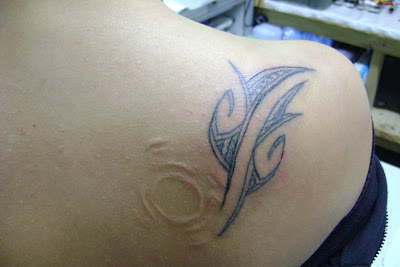
Rangi just started drawing on my shoulder, knowing what I wanted it to represent and then took a picture of it and waited for my okay.

Drawing of taa moko


Below: intro to the process


Below: The uhi at work


The end result!


I love it!

Me and Rangi Kipa post taa moko


To see more of what Rangi does, check out his website: http://www.rangikipa.com/

Sunday, January 25, 2009

"Swimming" with the Dolphins

One of the things I was excited to do while in Tauranga, was go swimming with the dophins. I've always wanted to swim with them in the wild. Though I loved the Miami Seaquarium summer camp, the animals were all in captivity and they'd been trained. So swimming with them doesn't have the same impact as out in the open.
I was soooooo excited! According to this company, Dolphin Seafaris, there is a 98% chance of seeing dolphins and a 89% chance of swimming with them. So I paid my $140 and set off to the marina. The owner, who was also the skipper, was very informative, telling us all kinds of stuff about the harbor and the history of the Maori people in the area. At times he was a bit too informative (silence would have been nice at times), but in all, it was nice to get so much information from him.
Dolphin Seafaris' boat
As we went along the water, we saw two cruise ships, one of them all the way from the Netherlands! What a trip! I love the picture below because it shows the contrast between the cruise ship and the small "tugboat"
Big mamma, versus little baby
So we set out from the marina and we headed out towards Mount Maunganui to pick up some other customers. On our way we saw a freighter and were told that the harbor here is the busiest harbor in the North Island and that container ships such as these would often carry lumber from New Zealand to China. In China, they would cut them down and make them into planks and then ship them back to New Zealand!
I know about this whole free trade thing, but it seems so silly to send your raw material somewhere else only to have it returned to you, altered. It's great for the Chinese, but not so good for the Kiwis who are out of work and could have used those jobs. Anyway, won't get involved in the politics of business...
Container ship bound for China

As we were leaving the Mount and heading for open waters, we passed by the mountain itself and were informed of a few interesting things. I think I mentioned most of the Maori history in the Mount entry, so I'll not repeat it. But at the exit/entrance of the harbor, there is a statue of a Maori warrior there, I guess as a reminder for the history coming from the Mount.

Statue of Maori Warrior with the Mount at the left of the photo

There is another interesting historical story that the skipper anounced to us. (I welcome any corrections from Shani if this is inaccurate somehow). As the South Pacific people were coming to Aotearoa (land of the long white cloud) they encountered really rough seas. They traveled in wakas (canoes) seating about 100 people. As they were struggling to survive on the rough seas, they thought they should make a sacrifice to the ocean to appease the roiling seas. They chose an old woman who had lived a good life and threw her overboard.

Today, the rocks you see in the picture below, is called the grandmother rocks, in memory of the sacrifices made to land on the shores of New Zealand. The skipper then asked people to throw ginger snaps at the rocks as a type of sacrifice that would allow us to have a good dolphin watching/swimming day.

Grandmother rocks on the far left (the three rocks)

The Mount shown from the sea


We headed out to the open ocean and I stayed outside the whole time, my eyes peeled and my camera at the ready. And guess what? We saw zero dolphins! I was the 2%. It was really disappointing, but we did see the following:

A sunfish. They can grow to about 1000kgs. There is not much information about them, but they are called sunfish because they like to float along the surface of the ocean, absorbing the suns rays. They kind of look like sharks and they let you get really close before diving down. Below, a video of a sunfish.


Multi-colored jellyfish. Isn't it beautiful? They come in pinks and purples and the more muted browns. These are bigger than dinner plates.

I finally saw some real life gannets! I didn't get to see them at Cape Kidnappers, but I got to see them that day! There is something to say about that!
You see how the water seems to be foaming there? It's called a boil-up. This means that a school of fish have been pushed close to the surface of the water by predators and their movement along the surface create this "boiling" effect. We tried going up to see them, but they quickly dispersed.
So we went home that day, a bit saddened by the lack of dolphins. We did see lots of different type of birds, including the JC bird, or Jesus Christ bird. Guess why they call them that? I look forward to hearing your thoughts.

We also saw flying fish. It was such an awesome thing! They have real, dragonfly-style wings and they swam a few inches from the water for a distance of about 5 meters. Apparently they can fly much further than that. Dolphins really like to eat these fish because they are relatively small (dolphins like to eat fish whole) and they are fun to play with (according to the skipper).

I got a voucher to come back another day. This is why I ended up spending two rather than one week in Tauranga.

I went back out on a Wednesday, 4 days later, and that time we saw dolphins! Here's a video of them swimming along the boat.

They were amazing! It was a small pod of about 12, but they hung around for about 30 minutes. Of course, we had to keep up with them, but we did and that was cool. The skipper mentioned that they would be close to a larger pod and that our chances of swimming with them would be better if the pod was about 40-50. We navigated around islands and such for several more hours, but didn't see any more dolphins. So, as a result, I didn't get to swim with them. These are the risks of trying to interact with wild animals. You can never predict the outcome. Lots of people were disappointed, but I was happy that I got to see them at all.

The skipper told us a story of how intelligent dolphins really are. Here it goes... A few years ago, a group of men were out fishing and they accidentally hooked a dolphin by its dorsal fin. Instead of swimming away and causing more damage to its fin (as most animals would do), it swam up to the stern and waited as the fishermen took out the hook from its fin. The dolphin then swam around and leapt up in the air as a sort of salute to the fishermen for taking the hook out and then proceeded to play with them for another half hour or so before swimming away. Pretty cool story, huh?

We also got to see a few blue penguins. I didn't get any pictures of them the first time we went out, but the second time, there was a lone one chilling on the surface of the water and it let us get really close by and I managed to record it. Enjoy!

Friday, January 23, 2009

Mount Maunganui

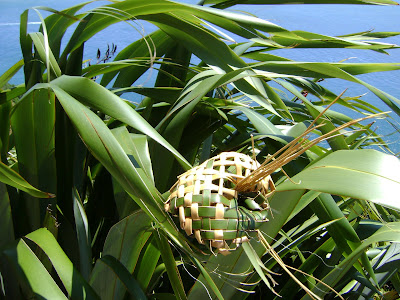
Someone weaved this from this flax plant. Some of it has died and the rest is still green. We saw it on our way up the Mount. Reminds me of the puti puti Shani made for me.
I've been told by lots of people to go up the Mount and see the view from the top. Was a bit nervous going up, after all, I'd had a chest infection (all gone now!) so wasn't sure how hard it would be on me. But it was so worth it and an easy walk at that! What a beautiful view from the top. On a such a gorgeous day, I couldn't have asked for more!

I've met some cool people at the backpackers and got a chance to go to Mount Maunganui with one of them, Joe from the UK. Without a car, you'd have to take the number 1 bus from outside the Information office to get to the Mount, about a 10 minute drive away from Tauranga.

We first walked over to Pleasure Island and I got some nice shots from there.
From Pleasure Island, looking out at the Mount

Ditto, different angle

Below, a video as we are making our way up the Mount. In the distance, to the left of the short, you can make out Pleasure Island where I took the pictures above.

Views on the way up the Mount

A Sun flower behind strange-looking bulbous plants

Below, a 360 degree view from the top of the Mount

Looking down at part of the path we took to get to the top (you can see the green along the shore; will explain further down)
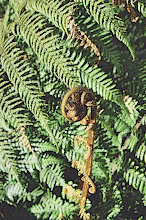
The fern is the national plant in New Zealand. Some look so prehistoric that it reminds me of the movie "The Land Before Time". Is it beautiful, Ducky? " Yup, Yup Yup!"


On this side of the mountain, you can see steppes carved out of the side. This was an ancient Maori pa site and the steppes were used as a form of protection from enemies. They would scatter crushed seashells on the ground. This would alert them at night, because of the noise and would also injure the enemies feet, making them less agile in battle.

As we came back down to the shore, there was a carpet of the following:


A shore mixing rocks and sand. The best of both worlds.

Tuesday, January 20, 2009

Tauranga

I arrived in Tauranga about a week and a half ago and will be leaving on Tuesday. So, I'm back in the Bay of Plenty but west of where I stayed when I first arrived in New Zealand. This place is absolutely gorgeous and much more of the coastal city/town/summer pad that I was hoping to find.

Below a little video of my first evening in Tauranga. A view of the bay/port from the roof/balcony of the Harbourside Backpackers. Not too shabby, eh?

There are tons of bars, cafes and restaurants on the Strand (what seems to be the common name in many coastal towns, for the street that's closest to the water, like the boardwalk). There are quite a few nightclubs too which is pretty cool after the one nightclub I had to contend with in Hastings for 2 1/2 months. Cafes also close later and the place that I'm sending this entry from is called Chaos, a definitive rock/metal head cafe which has the wonderful advantage of providing free internet if you purchase something as cheap as a coke. You can stay here for hours afterwards and no one bothers you. Definitely beats the $4/hour you find in other places! Only problem is, wireless is not as reliable as the cable internet...can't have it all, huh?

On my first weekend here, there was an international hydroplane competition literally across the street from the backpackers, so we had a bird's eye view of the show, and for free!!! But imagine, what it sounds like when a motorcycle is roaring down the street at 2am on a week night. These boats are 10 times louder than those damned motorcycles!

hydroplane being airlifted into the water
"showgrounds" with cranes and boats waiting for the race

Last Friday, I was sitting at a table and chairs next to the port minding my own business, having a coffee and a group of men in kilts were playing bagpipes. It was kind of strange, but cool at the same time. Thought you'd like to hear them practicing. (warning: I did say Irish bagpipes. I am aware of it now. I apologize. Wasn't thinking straight!)

Later on, some young Maori boys came up to me to ask for a cigarette. There were six of them. Two pairs of them were brothers and they were all first cousins, the sons of sisters. It was great to meet local boys, see what the modern Maori lifestyle is like. They were all born and raised in Tauranga and their ages ranged from 17 to 24. So once again, I'm the oldest in the group. I should be used to this by now! So a simple request for a cigarette turned into about 45 minutes of discussion and educational epiphanies. I learned a lot of new words from them.

Here they are:

loot: money

servo: service station, or gas station as we would say in North America

heiner: pretty girl (a compliment, not an insult)

smuck/darri: to smoke

Other words or expressions I've learned since I got to New Zealand:

sweet as: cool

push and play: exercise

dairy: convenience store/corner store

tea toatler(not sure of the spelling of this word): going around dry, without the influence of alcohol

Shout you a drink: treat you to a drink/offer you a drink; you can shout someone anything


Below, one of the boys, doing a modern-day haka for us. It was fun!


This is what traveling is all about!

Tuesday, October 21, 2008

Ohiwa Spit

Ohiwa Spit

Bev introduced me to a friend of hers that has a farm and would be interested in me doing some WWOOFing. WWOOFing stands for Willing Workers on Organic Farms. They don’t pay you, but in return for 4 hours of work a day, you have room and board. It’s a pretty sweet deal, but it didn’t end up working out this particular time. Ohiwa Water's Edge

Anyway, Jacqui invited me to go birdwatching with her. It was the annual birdwatching festival in Whakatane and since I had just arrived there and had never done that sort of thing before, I agreed to go along. She came to pick me up early Saturday morning (9am is early!) and we went to Ohiwa Spit. Keep in mind that a spit is a piece of land (sand dune/bank) that jutts out from the ground in a kind of peninsula. There is no protection from the elements and let me tell you, it was really, really cold!

We were welcoming the Godwits, birds that fly down from Alaska and Serbia for the season. I believe Godwits hold the world record for the longest single flight for land birds. They make the trip from Alaska to New Zealand in one week. Imagine that! Some of the birds are only 3 months old! They fatten up and then fly non-stop until they get to New Zealand.


So, we headed out to the Spit and with telescopes set up by the bird watch society, we could see them flying in. They are brown little birds with very long pointy beaks. The pictures don’t really show them well because they are too far, but the area was really beautiful and quite wild.
Driftwood and Reeds

A cold, but interesting day.

Monday, October 6, 2008

Whakatane


View of Whakatane from Toi's Pa
There are several great stories about Whakatane and its Maori history. It is a small, but quaint town, located in the Bay of Plenty in the North Island. It is supposedly one of the sunniest places in the country and though there was a lot of sun, many of these pictures happened to be taken on cloudy days. Sorry!

Something must be said for the beauty of storm clouds, though, so I still love these pictures.

Anyway, back to the legends. Bear with me because I'm sure I'm messing this up a little bit, but the general idea of the story is correct. Trust me!

Maoris are originally people from the South Pacific Islands (there is still a question mark as to where in Polynesia they come from). They immigrated to New Zealand around 1000B.C. As part of this immigration, one of the men (whose name I've forgotten) landed in the bay of Whakatane (which was nameless at the time) and he thought it was a perfect location for a new settlement. He sent word to the leader of the tribe that this was a perfect location and gave three landmarks as ways in which this leader could find the right place. There was a grouping of large boulders in the mouth of the Whakatane River that lets out into the ocean. They have since been destroyed by city lawmakers who wanted to make the river bank larger.


Whakatane River bank letting out onto the Pacific Ocean


The second landmark he referred to was a large cave that could house up to 60 people. He thought that Muriwai (a respected woman of the tribe) could live there. Today, the cave is partially collapsed, but it's interesting to see where people lived.

Muriwai's Cave


The third and last landmark and probably the most important was Wairere Falls, a waterfall that would ensure clean and fresh water for the settlement.

Wairere Falls


Obviously, they came and they settled! Whakatane is small, easily walkable and filled with really sweet people. The other day I was walking back to my hostel (by the way, I stayed at a really quaint gingerbread-type house run by a young couple: Lloyd's Lodge) and there was a guy on the street who was holding up a sign to promote 8 dollar- pizzas from Dominoes. As I walked past him, he said hello. I answered automatically and continued on. It is only about 5 seconds later that I realized that a perfect stranger had said hello to me without any reason. It was a delayed culture shock on my part. After two years of living in South Korea, where no strangers say hello, it was so incredibly bizarre and yet wonderful to get that kind of natural kindness.

Over the next couple of days, kids, adults, men and women would just say hello for no reason at all. It reminded me of Haiti and the casual greetings strangers would give each other on the streets as I was growing up. It is wonderful to feel that again. I had gotten used to the silences of North America, Europe and Asia...

Storm Clouds in Whakatane harbor

Anyway, back to some history. Now is the story of how Whakatane got its name. About 200 years after the first settlement in the area, a group of men led by Toroa had sailed in on a canoe to where the river and ocean met. They got out and went to meet the local leaders but they didn't secure the canoe very well and as the tide rose, the canoe started to drift away. Wairaka,
Toroa's daughter saw that the canoe was drifting away. Traditionally, however, women were forbidden to steer a canoe (called waka in Maori), so she cried out 'E! Kia whakatane aui ahau!'(let me turn into a man) and so jumped into the canoe and paddled it into safety. After that bravery, they named the town in honor of her deed.

In the place where she supposedly saved the canoe, a statue stands to commemorate her.

Statue of Wairaka

From the top of the mountain above Whakatane, there is a great view of the city and of the islands off the coast. If you remember the story of White Island and Whale Island, below is a picture of Whale Island.

Whale Island

Funny seed from a tree downtown
Natural Tunnel?

Cool-looking statue

White Island (or Whakaari)

The story of White Island is a wonderful one. There are many legends about the existence of pretty much everything in this world. One of the Maori legends talks about two mountain sisters, Whakaari and Motuhora (Whale Island). I think they were looking for a new place to live and they set off separately and were supposed to meet up later. When Motuhora couldn't find her sister, she went to look for her and followed the grooves Whakaari had made in her wake. She was speeding towards Whakaari and when the latter saw her, she jumped out of the way and ended up 50 km off the coast of Whakatane. Moruhora settled herself closer, 9 km away.
White Island is one of three active volcanoes in New Zealand, this one being the most active and the only marine volcano. We set off on a Monday morning, the sun was bright overhead and we expected only the best. That's exactly what we got.
It took about an hour and a half to get to the island. It is uninhabited and spouts steam up into the air, as if smoking.
The yacht stayed a bit off shore and we got to the island by motorboat.
The tour was very professional and they even fed us a small soup and bread breakfast on the way to the island with little stories along the way. They also fed us a box lunch on board after the visit.
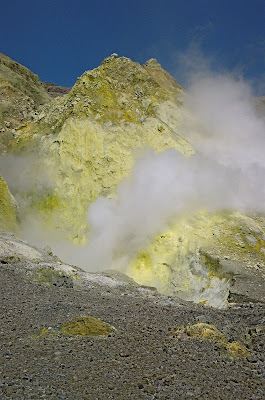
After arriving on the island, we were taken along to see all the sulfur deposits that you see above.
Steam rose from holes in white mounds of minerals. The steam was 100 degrees Celsius and could regularly go up to 300 degrees. They were also able to record temperatures of up to 800 degrees! We had to wear hard hats in case of unexpected eruptions or rock slides and gas masks in case the gas emitted was too strong to breath in.
It was really cool!
These are called sulfur flowers. With the pressure of the steam, little crystalized flower-like formations would appear at the opening of a vent. This is only about a week old.
Amazing what colors nature can give us. I like to think of it as liquid silver and...a yellow like I've never seen. My words betray me here. It was just incredible to see these kinds of colors in such accidental (or not) ways.
More amazing colors. Coppers and moss greens, corals and metallic reds...
Later we reached a section of the island where there was this gigantic crater called the crater complex. Here I am standing in front of it, below.
But the picture doesn't do it just. It was this milky green lake, wispy clouds of steam rising from in one of the most mystically beautiful experiences of my life. A woman I met at the cottage who agreed to drive me to Whakatane with her husband, described the lake as ethereal and in truth, that's the only way to describe it.
Some people say that it's like stepping onto another planet and yes, I guess it is, in a way, but most importantly, it's like stepping into a land of fantasy, one of those comic books or alternate world movies where things like that only seem like figments of our imagination. Nothing that could actually be real.
But somehow, it is real and you do see it for yourself. So, for a moment there, I was mesmerized into silence at the wonder of what our earth can create.
I wanted you to have an idea of what it was like, so I recorded it. The image is not so good, but I'm hoping that it will make you dream, just a little...

After the crater complex, we started heading back to the shore. On the way, we saw plenty of other beautiful things.
Including, real boiling mud pits...
As we neared the shore, we came upon what used to be a sulfur factory. People used to live on this island and mine sulfur. They would have to brush their teeth three times a day to keep them from going black. The best article of clothing to wear was wool because it was the only thing that lasted longer than one month. Everything else wore away because of the minerals and salt from the sea. But wool was a terrible choice because the temperatures could go up into the 30s and it was obviously extremely hot.
Remnants of an old tractor.

What's left of the factory with the yacht in the distance. I love this picture, showing modern man's machines versus the machines of old.

As we headed back to the yacht, there was a very obvious milky quality to the water. That was the current that the sulfur took into the ocean. Apparently, it didn't really affect the sealife there. Many people come here every year to dive in the area. People also come to fish here. They can do that in a very specific area around the island. Things are very reglemented in New Zealand. I think that's the only way they can do that without destroying the things that make New Zealand the pristine country that it is. I'm really impressed with their conservation methods and with how so many people are dedicated in keeping it this way. I have a lot of respect for that.

And because it was such a beautiful day and the waters were calm, we were able to navigate around the island to see what the rest of the island looked like. It wasn't all barren land. On the other side there were traditional New Zealand trees called Pohutukawa. They flower in Christmastime and so are called Christmas trees here. I can't wait for them to bloom.

But a lot of the trees look like this...

They have been chemically burned from the ash falling on them. After the ash falls from an eruption, it rains and the ash turns into a kind of paste which basically burns the trees until they die. No fire or flame is involved, instead it is a slow death.

When it rains on Whakaari and people are visiting it, they get acid rain. They can feel the stinging on their faces. The guide, a woman, cheekily said that it was a free chemical peel. I laughed out loud.

Below a little video of the island to show what the other side looks like. It was a much bigger island than I had expected.