Showing posts with label Rotorua. Show all posts

Wednesday, November 26, 2008

Wai-O-Tapu

Sometime during my trip to Rotorua, I decided to go to Wai-o- Tapu, what the Paikiha (white Kiwis) call the Thermal Wonderland. I don't like that term because it kind of sounds like some kind of Theme Park. When translated from Maori, it means Sacred Waters... and that is so much more accurate. So I went on a trip to this beautiful place of sacred colored waters and what a place! I received a map of the place and let me tell you, it takes a good 2 hours to go through all the places. We only had 1 1/2 hours to visit because I was on a shuttle bus ( I have no car) and so was restricted on time. I do recommend you come here on a day when you have no restrictions because there is a little cafeteria and a gift store where you can chill out before, after or during your time there. The concept is that there are several pools of "water" having different names related to what people thought they might represent. First we went to see some of the bubbling pools of mud. That was pretty cool because it's not every day that you see mud literally boiling in front of your eyes. The best part is that it is completely natural! How insane is that?!
Bubbling Mud

Bubbling Mud in Action
Afterwards we were taken to Lady Knox, a well-known geyser that erupts at 10:15a.m. every morning (they help it along with soap). I hear it's similar to that of the park in the US (I'm currently forgetting the name because I'm a bit tipsy as I write this...it's Friday and I have two consecutive days off from work and it's been 6 weeks since I've had this opportunity. SO....you can imagine the giddiness I felt and the subsequent need to celebrate) .
Lady Knox in Wait
Anyway, I videoed the geyser erupting but as I said in an earlier message, I took it vertically and can't figure out how to turn it around ( I apologize for any cricks in your necks!).

Lady Knox in Motion

Lady Knox and Me
After the mudflats and the geyser we went into Wai-o-Tapu, but once again I forgot to bring in my journal to tell you the exact names of each of the pools. Sorry! Work has got me wonky!
I hope you will enjoy the sights, though, and know that these pictures are truly of sacred waters.
Heart-shaped face An acorn's home
A little history of how volcanoes have shaped New Zealand ( New Zealand is on the Ring of Fire, a global map of where the world's most active volcanoes in the Pacific Ocean are located. Red lights in the Rotorua Museum were lit up all over this country!) The Artist's Palette The Champagne Pool Steaming River
Is it Moss or chemical composites? A Mud Plateau
Another Artist's Palette
Fingers of Fluorescence
A Separate World
Moss-Covered Rocks
People walking through the different pools
Moss-Covered Bark
Devil's Ink Pot
The Devil's Bath. Look at that incredible color!
Close-up of the Champagne Pool - looks like something from outer space
A Strange Beach...
Bubbling water - like blowing in your bathtub! (or farting....)
Multi-colored Pool

Thursday, November 6, 2008

Rotorua Relaxing

Whale bone club

As I must have mentioned before, I met a really cool Maori tattoo artist named Kaianga in Rotorua. We spent about 5 days talking together, learning from each other's culture, language, food... but I spent most of the time asking questions and waiting with baited breath and eyes wide open, for the intricate answers that were to come. Though not all Maoris speak the language, nor do they all know that much about their history and culture, this man does and I was blessed to have had the opportunity to meet him.
He taught me a Maori action song that they play for kids, where you learn the colors of the rainbow and you point to the color you are singing. It's a lot of fun! And you really do feel like a kid!

One afternoon, I mentioned the fact that I wanted to try Puha, a "weed" as the white Kiwis consider it, I think from the dandelion family. Maoris eat it and though there were plenty of puhas to choose from at Mimiha cottage, I didn't know how to cook it and wanted to try it properly from someone who knew how to do it before I tried cooking it myself.

Kaianga was really excited and had spotted this really big puha in the backyard of the backpackers. So we decided to have a "boil-up" that night. I wasn't really sure what that was but we went out to the butcher's, bought some meat and then he went out along the highway and found some more wild puha, got some potatoes and kumara and then we reassembled at the backpackers and the meal was on. He showed me how to cook it and I wrote down the recipe, which incidentally I don't have with me as I'm writing this and I stupidly forgot to take a picture of it, but it's kind of like Haitian "bouillon" in the sense that you stew the meat for about 2 hours and then add the puha, potatoes and kumara and then let it simmer for another hour. I asked him about spices and he said we didn't need any. I found that really strange and thought that it would be really bland, but I was really pleasantly surprised. The puha provided all the spice you needed. All we added was a little sea salt and it was done.

We had a delicious meal along with Alix and two young kiwis, a couple...he's 20 and she just turned 18 and they are pregnant. That's something else about New Zealand that I find really surprising. People have kids and get married really, really young here. You'll regularly find 45 year olds who are grandparents. It's so beyond me. They are cute though, and I do hope they make it.

Me and Kaianga with Alix in the background

After dinner, we went to see a movie, actually a documentary, called Rain of the Children...a true story of a Maori woman who had 14 children and lost them all. It's much more complex than that, but if you get the chance to see it, I really recommend it. Kaianga fell asleep and I was really surprised, but he said that it was a little too close to home and hadn't expected it to be so emotional so he just shut off. I can understand that. I was emotional too, yet I can't directly relate because I'm not from here.

Anyway, to go back to a more general explanation of my time there, I did not expect to have such a spiritual experience in Rotorua, meeting Kaianga as well as a French woman, Alix, at the same time. I remember sitting outside at a picnic table smoking menthols and drinking wine and then the next moment I was involved in conversations about the meaning of life, the Mayan calendar, ancestors visiting Maori tattoo artists in their sleep and finding the reason for being here... I was lightheaded by the overflow of information being exchanged. It was exhilerating and exhausting at the same time. I loved it. I have yet to find that energy since, but it has stayed with me and I'm grateful for having met them.

Kaianga suggested that I go to Hastings, a town along the east coast of the North Island, to find seasonal work and since he comes from the Mahia peninsula, not too far away from there, I figured we'd get a chance to meet again.

But again, I learned so much from him and I don't think that it's over quite yet. He also carves wood and stone and the day before I left, he gave me a piece of jade that he had found a while back. It was just waiting for the right owner and he decided that I was that owner. He told me that I needed to find someone who could make it into a necklace for me. I was honored that he would give me such a gift. I had nothing to give him in return. But I think we'll see each other again and perhaps I'll have something to give in return. He told me to trust that I would find someone to make this stone into a neckland and I did...but that's another story to come.

Rotorua on a Sunny Day

He showed me some of his carvings in the stones and also explained to me that a lot of the time, the Maori artifacts he has often come from a bartering system: he has something someone wants, like the ability to give a tattoo, or a carving and they would have something like the whale bone club above. He also plays music, including the guitar and various Maori instruments. Below, a video of a Maori flute with Kaianga playing it.

Enjoy!

Wednesday, October 29, 2008

Mitai Maori Village


Hey guys,

Sorry for the long delay. I've been really busy, actually, but I'll get to that in an eventual entry.
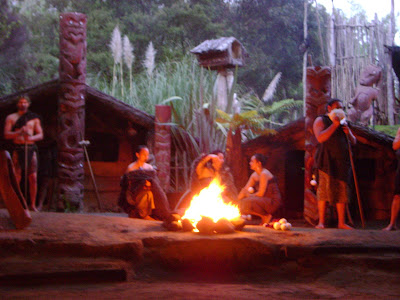
Traditional Scene

Still in Rotorua, on one of the nights, I went to a very touristic but amazing place: the Mitai Maori Village. You pay $80NZ and you see how the Maori used to live, the songs they sang, their customs and they had a traditional meal, called a Hangi.
The Hangi
The hangi was traditionally sweet potato, potato and meat (in this case, chicken and lamb) cooked underground in an earthenware pot. Now, though, because of the strict health and safety regulations, you can't use earthenware anymore, so they use metal instead. In addition to the show and food, there was a little walk in the woods, first to see how the Maori rowed their canoes and the singing they did and then, later on to see the glow worms around a natural spring that provided fresh water for the tribe for centuries. The water we drank at dinner was from that spring. The water is really cold, somewhere below 10degrees Celsius.

Rowing backwards

I'll let the videos tell you most of the story, but you all know that nothing compares to actually seeing it for real. Most of the people had painted on the tattooes they would have had in the past, but the chief actually had real tattoes from his navel down to his knees. It's really impressive.
If you look carefully, you can just make out the tatooes from his lower back and down.
What is also interesting about this place is that of 103 people working there and running the opertations, 101 of those people are from the same family. It's really a family business and it really keeps the culture alive for the young. I love that.
The Chief
Something you have to keep in mind is that every Maori tribe has different dances. The Haka, the warrior dance that some of you might have seen when watching Kiwis play Rugby against other countries, is different from tribe to tribe and that's a really cool thing.

Challenging the Enemy
The men and women open there eyes really wide so that the enemies could see the whites and it is quite the intimidation technique. The men also stick their tongues out, and it actually meant that they meant to eat their enemies. Most, but not all, Maori tribes were cannibals, so it wasn't just a scare tactic, it was also a promise of what was to come. Isn't that cool? The tongue thing, I mean.

Opening Ceremony
I will not go into it today, but I will dedicate an entry on the tattooing culture here and explain to you the significance. It's not like how in the west people just choose something random at times, just cause they want a tattoo. Not all Maoris had them, but those that did, all told a very specific story. I'll let that stew with you and tell you more some other day. For now, enjoy the images.

Rowing Forward
Maori culture is alive and well here. I was so utterly impressed how well they've preserved their culture. They actually have two TV channels just for the Maoris. One is called Maori Television and they have all kinds of programs, including international shows that are really interesting. They often have Maori language shows with English subtitles for people like me who can't understand a thing! I'm grateful! They have other shows where they introduce and talk about a particular element of the culture, for example introducing and demonstrating the use of their traditional instruments. Other shows include the National Maori Competition of singing and dancing. They take high school students from across the country and they compete to see who sings and dances the best. The other channel is called Te Oro (I think!) and it's completely in Maori with no subtitles, so that was tough for me. Even on regular non-cable TV, there is the news that comes on a few times a day and is completely in Maori.
Anyway, to go back to the dancing: a few tips. They always make their hands shake, as though you were trembling and this signifies the energy that we're all a part of. The Poi dance was originally not a dance, but an exercise that the men did to strengthen their wrists for combat. The women later took it and made it into a dance more for touristic purposes than because it was necessary. Today, it shows the women's incredible dexterity. Poi are little balls that were weighted in the past and men would flick them back and forth in order to prepare for the heavy spears they used in combat.

Poi dance
I apologize for the videos which are sideways. For the life of me, I can't figure out how to rotate it. It's really frustrating!
I hope that there will be many more chances to learn about Maori culture for me. That's why I came here!

Tuesday, October 21, 2008

Rotorua


I went to Rotorua a couple of weeks ago. I decided to spend a week there taking in the sights at a reasonable pace, letting things sink in . I stayed at a very cool backpackers with awesome owners (Rotorua Central Backpackers). I have to say I'm not really into backpackers hostels because you are sharing your room with strangers, but you do get a chance to meet people and make some connections, so it's doable.
On my first day, I walked around, with nothing particular in mind. I had lunch at a fabulous restaurant called Relish. I found out later that Lonely Planet had recommended it. I had lamb shanks with mashed kumara (Maori word for sweet potato), wild mushrooms and shallots. Yummy!


It was pretty rainy after that, so I returned to the hostel and didn't walk around much. On Tuesday I relaxed a bit and went to the government office here so that I could register for a work ID. The bureaucracy here is super simple and easy. What a nice change.


Wednesday was a busier day, despite the almost constant rain that fell that day. Catherine, the head of the hostel, had drawn me a little map of a walk that I could take if I wanted to see what was in and around the city. I took her up on the offer. It was a two-hour walk and I started out at the Kuirau Park and as I walked through it I encountered these gorgeous trees whose flowers had begun to drop and other flowers covering bridges. I think it would be a couple's paradise.

Kuirau Park

Wisteria-covered bridge


In the park you can find tons of natural hot mineral pools...

Let me backtrack. Rotorua is the epicenter of natural mineral pools in New Zealand. Many people who know about New Zealand, know about it because of Rotorua. For over a hundred years, people have been coming for the healing effects of these pools. Rotorua smells like rotten eggs. It's a sulfur paradise. The Blue Baths used to be where people would come to heal from all sorts of ailments, including depression, skin problems and muscle pains.

I've been told that many people go there for a week and then leave New Zealand feeling they have seen the country because in addition to the pools, this is Maori culture central. The culture here is very present and there are tons of tours and Maori experiences you can have that have been set up since the mineral pools became popular.

Of course, as you've already seen, there is already more to New Zealand than Rotorua, but this place is pretty darned amazing. Anyway, as I walked through the park, these are the types of pools I encountered. You can't bathe in these pools though.

Natural Steaming Pools in Kuira Park


After the park I continued on to Ohinemutu village, a typical modern Maori village. You could still see the elements of traditional culture clearly, though. A marae is a meeting house, I guess kind of like churches in Western society. But in addition to the marae was also an Anglican church. The old and the new...

Ohinemutu Village


A Maori Marae (pronounced "mara-ee")


Carving

Wae Wae (Amo-leg)

All around the houses were little smoking pools of sulfur, it was quite cool. If you continue along the edge of the water (Rotorua lake), there are tons of birds breeding in the Government Gardens, some of them relatively rare. It was a beautiful walk. On the pier, I encountered black swans which are not indigenous of New Zealand, but were brought here as ornamental birds. They were really beautiful.

But...


And yet you still found mothers and fathers giving their 5 year old children bread to feed to them. Some people really don't listen. If I could have taken a picture of the irony, I would have, but I didn't get a chance, sorry!
But look at this part of a sign in the government gardens about gulls. It cracked me up!

Hmmm...I can be dive-bombed by these guys, but I shouldn't be alarmed?! Okaaaaaay....

At the end of the these gardens were where you could see the color of the lake change. There, the smells were stronger and reminiscent of White Island. The lake became a milky whitish/yellowish tinge and I don't think very much lives there. At the edge of this area is the Rotorua Museum and old bath houses from the 1800s as well as the Polynesian spa where people can still bathe today in these healing waters.

Rocky Point

Cool sign in front of a fast food place