Thursday, November 6, 2008

Rotorua Relaxing

Whale bone club

As I must have mentioned before, I met a really cool Maori tattoo artist named Kaianga in Rotorua. We spent about 5 days talking together, learning from each other's culture, language, food... but I spent most of the time asking questions and waiting with baited breath and eyes wide open, for the intricate answers that were to come. Though not all Maoris speak the language, nor do they all know that much about their history and culture, this man does and I was blessed to have had the opportunity to meet him.
He taught me a Maori action song that they play for kids, where you learn the colors of the rainbow and you point to the color you are singing. It's a lot of fun! And you really do feel like a kid!

One afternoon, I mentioned the fact that I wanted to try Puha, a "weed" as the white Kiwis consider it, I think from the dandelion family. Maoris eat it and though there were plenty of puhas to choose from at Mimiha cottage, I didn't know how to cook it and wanted to try it properly from someone who knew how to do it before I tried cooking it myself.

Kaianga was really excited and had spotted this really big puha in the backyard of the backpackers. So we decided to have a "boil-up" that night. I wasn't really sure what that was but we went out to the butcher's, bought some meat and then he went out along the highway and found some more wild puha, got some potatoes and kumara and then we reassembled at the backpackers and the meal was on. He showed me how to cook it and I wrote down the recipe, which incidentally I don't have with me as I'm writing this and I stupidly forgot to take a picture of it, but it's kind of like Haitian "bouillon" in the sense that you stew the meat for about 2 hours and then add the puha, potatoes and kumara and then let it simmer for another hour. I asked him about spices and he said we didn't need any. I found that really strange and thought that it would be really bland, but I was really pleasantly surprised. The puha provided all the spice you needed. All we added was a little sea salt and it was done.

We had a delicious meal along with Alix and two young kiwis, a couple...he's 20 and she just turned 18 and they are pregnant. That's something else about New Zealand that I find really surprising. People have kids and get married really, really young here. You'll regularly find 45 year olds who are grandparents. It's so beyond me. They are cute though, and I do hope they make it.

Me and Kaianga with Alix in the background

After dinner, we went to see a movie, actually a documentary, called Rain of the Children...a true story of a Maori woman who had 14 children and lost them all. It's much more complex than that, but if you get the chance to see it, I really recommend it. Kaianga fell asleep and I was really surprised, but he said that it was a little too close to home and hadn't expected it to be so emotional so he just shut off. I can understand that. I was emotional too, yet I can't directly relate because I'm not from here.

Anyway, to go back to a more general explanation of my time there, I did not expect to have such a spiritual experience in Rotorua, meeting Kaianga as well as a French woman, Alix, at the same time. I remember sitting outside at a picnic table smoking menthols and drinking wine and then the next moment I was involved in conversations about the meaning of life, the Mayan calendar, ancestors visiting Maori tattoo artists in their sleep and finding the reason for being here... I was lightheaded by the overflow of information being exchanged. It was exhilerating and exhausting at the same time. I loved it. I have yet to find that energy since, but it has stayed with me and I'm grateful for having met them.

Kaianga suggested that I go to Hastings, a town along the east coast of the North Island, to find seasonal work and since he comes from the Mahia peninsula, not too far away from there, I figured we'd get a chance to meet again.

But again, I learned so much from him and I don't think that it's over quite yet. He also carves wood and stone and the day before I left, he gave me a piece of jade that he had found a while back. It was just waiting for the right owner and he decided that I was that owner. He told me that I needed to find someone who could make it into a necklace for me. I was honored that he would give me such a gift. I had nothing to give him in return. But I think we'll see each other again and perhaps I'll have something to give in return. He told me to trust that I would find someone to make this stone into a neckland and I did...but that's another story to come.

Rotorua on a Sunny Day

He showed me some of his carvings in the stones and also explained to me that a lot of the time, the Maori artifacts he has often come from a bartering system: he has something someone wants, like the ability to give a tattoo, or a carving and they would have something like the whale bone club above. He also plays music, including the guitar and various Maori instruments. Below, a video of a Maori flute with Kaianga playing it.

Enjoy!

Wednesday, October 29, 2008

Mitai Maori Village


Hey guys,

Sorry for the long delay. I've been really busy, actually, but I'll get to that in an eventual entry.
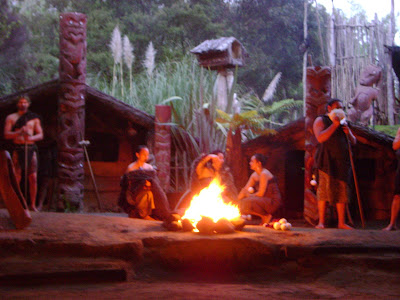
Traditional Scene

Still in Rotorua, on one of the nights, I went to a very touristic but amazing place: the Mitai Maori Village. You pay $80NZ and you see how the Maori used to live, the songs they sang, their customs and they had a traditional meal, called a Hangi.
The Hangi
The hangi was traditionally sweet potato, potato and meat (in this case, chicken and lamb) cooked underground in an earthenware pot. Now, though, because of the strict health and safety regulations, you can't use earthenware anymore, so they use metal instead. In addition to the show and food, there was a little walk in the woods, first to see how the Maori rowed their canoes and the singing they did and then, later on to see the glow worms around a natural spring that provided fresh water for the tribe for centuries. The water we drank at dinner was from that spring. The water is really cold, somewhere below 10degrees Celsius.

Rowing backwards

I'll let the videos tell you most of the story, but you all know that nothing compares to actually seeing it for real. Most of the people had painted on the tattooes they would have had in the past, but the chief actually had real tattoes from his navel down to his knees. It's really impressive.
If you look carefully, you can just make out the tatooes from his lower back and down.
What is also interesting about this place is that of 103 people working there and running the opertations, 101 of those people are from the same family. It's really a family business and it really keeps the culture alive for the young. I love that.
The Chief
Something you have to keep in mind is that every Maori tribe has different dances. The Haka, the warrior dance that some of you might have seen when watching Kiwis play Rugby against other countries, is different from tribe to tribe and that's a really cool thing.

Challenging the Enemy
The men and women open there eyes really wide so that the enemies could see the whites and it is quite the intimidation technique. The men also stick their tongues out, and it actually meant that they meant to eat their enemies. Most, but not all, Maori tribes were cannibals, so it wasn't just a scare tactic, it was also a promise of what was to come. Isn't that cool? The tongue thing, I mean.

Opening Ceremony
I will not go into it today, but I will dedicate an entry on the tattooing culture here and explain to you the significance. It's not like how in the west people just choose something random at times, just cause they want a tattoo. Not all Maoris had them, but those that did, all told a very specific story. I'll let that stew with you and tell you more some other day. For now, enjoy the images.

Rowing Forward
Maori culture is alive and well here. I was so utterly impressed how well they've preserved their culture. They actually have two TV channels just for the Maoris. One is called Maori Television and they have all kinds of programs, including international shows that are really interesting. They often have Maori language shows with English subtitles for people like me who can't understand a thing! I'm grateful! They have other shows where they introduce and talk about a particular element of the culture, for example introducing and demonstrating the use of their traditional instruments. Other shows include the National Maori Competition of singing and dancing. They take high school students from across the country and they compete to see who sings and dances the best. The other channel is called Te Oro (I think!) and it's completely in Maori with no subtitles, so that was tough for me. Even on regular non-cable TV, there is the news that comes on a few times a day and is completely in Maori.
Anyway, to go back to the dancing: a few tips. They always make their hands shake, as though you were trembling and this signifies the energy that we're all a part of. The Poi dance was originally not a dance, but an exercise that the men did to strengthen their wrists for combat. The women later took it and made it into a dance more for touristic purposes than because it was necessary. Today, it shows the women's incredible dexterity. Poi are little balls that were weighted in the past and men would flick them back and forth in order to prepare for the heavy spears they used in combat.

Poi dance
I apologize for the videos which are sideways. For the life of me, I can't figure out how to rotate it. It's really frustrating!
I hope that there will be many more chances to learn about Maori culture for me. That's why I came here!

Tuesday, October 21, 2008

Rotorua


I went to Rotorua a couple of weeks ago. I decided to spend a week there taking in the sights at a reasonable pace, letting things sink in . I stayed at a very cool backpackers with awesome owners (Rotorua Central Backpackers). I have to say I'm not really into backpackers hostels because you are sharing your room with strangers, but you do get a chance to meet people and make some connections, so it's doable.
On my first day, I walked around, with nothing particular in mind. I had lunch at a fabulous restaurant called Relish. I found out later that Lonely Planet had recommended it. I had lamb shanks with mashed kumara (Maori word for sweet potato), wild mushrooms and shallots. Yummy!


It was pretty rainy after that, so I returned to the hostel and didn't walk around much. On Tuesday I relaxed a bit and went to the government office here so that I could register for a work ID. The bureaucracy here is super simple and easy. What a nice change.


Wednesday was a busier day, despite the almost constant rain that fell that day. Catherine, the head of the hostel, had drawn me a little map of a walk that I could take if I wanted to see what was in and around the city. I took her up on the offer. It was a two-hour walk and I started out at the Kuirau Park and as I walked through it I encountered these gorgeous trees whose flowers had begun to drop and other flowers covering bridges. I think it would be a couple's paradise.

Kuirau Park

Wisteria-covered bridge


In the park you can find tons of natural hot mineral pools...

Let me backtrack. Rotorua is the epicenter of natural mineral pools in New Zealand. Many people who know about New Zealand, know about it because of Rotorua. For over a hundred years, people have been coming for the healing effects of these pools. Rotorua smells like rotten eggs. It's a sulfur paradise. The Blue Baths used to be where people would come to heal from all sorts of ailments, including depression, skin problems and muscle pains.

I've been told that many people go there for a week and then leave New Zealand feeling they have seen the country because in addition to the pools, this is Maori culture central. The culture here is very present and there are tons of tours and Maori experiences you can have that have been set up since the mineral pools became popular.

Of course, as you've already seen, there is already more to New Zealand than Rotorua, but this place is pretty darned amazing. Anyway, as I walked through the park, these are the types of pools I encountered. You can't bathe in these pools though.

Natural Steaming Pools in Kuira Park


After the park I continued on to Ohinemutu village, a typical modern Maori village. You could still see the elements of traditional culture clearly, though. A marae is a meeting house, I guess kind of like churches in Western society. But in addition to the marae was also an Anglican church. The old and the new...

Ohinemutu Village


A Maori Marae (pronounced "mara-ee")


Carving

Wae Wae (Amo-leg)

All around the houses were little smoking pools of sulfur, it was quite cool. If you continue along the edge of the water (Rotorua lake), there are tons of birds breeding in the Government Gardens, some of them relatively rare. It was a beautiful walk. On the pier, I encountered black swans which are not indigenous of New Zealand, but were brought here as ornamental birds. They were really beautiful.

But...


And yet you still found mothers and fathers giving their 5 year old children bread to feed to them. Some people really don't listen. If I could have taken a picture of the irony, I would have, but I didn't get a chance, sorry!
But look at this part of a sign in the government gardens about gulls. It cracked me up!

Hmmm...I can be dive-bombed by these guys, but I shouldn't be alarmed?! Okaaaaaay....

At the end of the these gardens were where you could see the color of the lake change. There, the smells were stronger and reminiscent of White Island. The lake became a milky whitish/yellowish tinge and I don't think very much lives there. At the edge of this area is the Rotorua Museum and old bath houses from the 1800s as well as the Polynesian spa where people can still bathe today in these healing waters.

Rocky Point

Cool sign in front of a fast food place

Ohiwa Spit

Ohiwa Spit

Bev introduced me to a friend of hers that has a farm and would be interested in me doing some WWOOFing. WWOOFing stands for Willing Workers on Organic Farms. They don’t pay you, but in return for 4 hours of work a day, you have room and board. It’s a pretty sweet deal, but it didn’t end up working out this particular time. Ohiwa Water's Edge

Anyway, Jacqui invited me to go birdwatching with her. It was the annual birdwatching festival in Whakatane and since I had just arrived there and had never done that sort of thing before, I agreed to go along. She came to pick me up early Saturday morning (9am is early!) and we went to Ohiwa Spit. Keep in mind that a spit is a piece of land (sand dune/bank) that jutts out from the ground in a kind of peninsula. There is no protection from the elements and let me tell you, it was really, really cold!

We were welcoming the Godwits, birds that fly down from Alaska and Serbia for the season. I believe Godwits hold the world record for the longest single flight for land birds. They make the trip from Alaska to New Zealand in one week. Imagine that! Some of the birds are only 3 months old! They fatten up and then fly non-stop until they get to New Zealand.


So, we headed out to the Spit and with telescopes set up by the bird watch society, we could see them flying in. They are brown little birds with very long pointy beaks. The pictures don’t really show them well because they are too far, but the area was really beautiful and quite wild.
Driftwood and Reeds

A cold, but interesting day.

Monday, October 6, 2008

Whakatane


View of Whakatane from Toi's Pa
There are several great stories about Whakatane and its Maori history. It is a small, but quaint town, located in the Bay of Plenty in the North Island. It is supposedly one of the sunniest places in the country and though there was a lot of sun, many of these pictures happened to be taken on cloudy days. Sorry!

Something must be said for the beauty of storm clouds, though, so I still love these pictures.

Anyway, back to the legends. Bear with me because I'm sure I'm messing this up a little bit, but the general idea of the story is correct. Trust me!

Maoris are originally people from the South Pacific Islands (there is still a question mark as to where in Polynesia they come from). They immigrated to New Zealand around 1000B.C. As part of this immigration, one of the men (whose name I've forgotten) landed in the bay of Whakatane (which was nameless at the time) and he thought it was a perfect location for a new settlement. He sent word to the leader of the tribe that this was a perfect location and gave three landmarks as ways in which this leader could find the right place. There was a grouping of large boulders in the mouth of the Whakatane River that lets out into the ocean. They have since been destroyed by city lawmakers who wanted to make the river bank larger.


Whakatane River bank letting out onto the Pacific Ocean


The second landmark he referred to was a large cave that could house up to 60 people. He thought that Muriwai (a respected woman of the tribe) could live there. Today, the cave is partially collapsed, but it's interesting to see where people lived.

Muriwai's Cave


The third and last landmark and probably the most important was Wairere Falls, a waterfall that would ensure clean and fresh water for the settlement.

Wairere Falls


Obviously, they came and they settled! Whakatane is small, easily walkable and filled with really sweet people. The other day I was walking back to my hostel (by the way, I stayed at a really quaint gingerbread-type house run by a young couple: Lloyd's Lodge) and there was a guy on the street who was holding up a sign to promote 8 dollar- pizzas from Dominoes. As I walked past him, he said hello. I answered automatically and continued on. It is only about 5 seconds later that I realized that a perfect stranger had said hello to me without any reason. It was a delayed culture shock on my part. After two years of living in South Korea, where no strangers say hello, it was so incredibly bizarre and yet wonderful to get that kind of natural kindness.

Over the next couple of days, kids, adults, men and women would just say hello for no reason at all. It reminded me of Haiti and the casual greetings strangers would give each other on the streets as I was growing up. It is wonderful to feel that again. I had gotten used to the silences of North America, Europe and Asia...

Storm Clouds in Whakatane harbor

Anyway, back to some history. Now is the story of how Whakatane got its name. About 200 years after the first settlement in the area, a group of men led by Toroa had sailed in on a canoe to where the river and ocean met. They got out and went to meet the local leaders but they didn't secure the canoe very well and as the tide rose, the canoe started to drift away. Wairaka,
Toroa's daughter saw that the canoe was drifting away. Traditionally, however, women were forbidden to steer a canoe (called waka in Maori), so she cried out 'E! Kia whakatane aui ahau!'(let me turn into a man) and so jumped into the canoe and paddled it into safety. After that bravery, they named the town in honor of her deed.

In the place where she supposedly saved the canoe, a statue stands to commemorate her.

Statue of Wairaka

From the top of the mountain above Whakatane, there is a great view of the city and of the islands off the coast. If you remember the story of White Island and Whale Island, below is a picture of Whale Island.

Whale Island

Funny seed from a tree downtown
Natural Tunnel?

Cool-looking statue

White Island (or Whakaari)

The story of White Island is a wonderful one. There are many legends about the existence of pretty much everything in this world. One of the Maori legends talks about two mountain sisters, Whakaari and Motuhora (Whale Island). I think they were looking for a new place to live and they set off separately and were supposed to meet up later. When Motuhora couldn't find her sister, she went to look for her and followed the grooves Whakaari had made in her wake. She was speeding towards Whakaari and when the latter saw her, she jumped out of the way and ended up 50 km off the coast of Whakatane. Moruhora settled herself closer, 9 km away.
White Island is one of three active volcanoes in New Zealand, this one being the most active and the only marine volcano. We set off on a Monday morning, the sun was bright overhead and we expected only the best. That's exactly what we got.
It took about an hour and a half to get to the island. It is uninhabited and spouts steam up into the air, as if smoking.
The yacht stayed a bit off shore and we got to the island by motorboat.
The tour was very professional and they even fed us a small soup and bread breakfast on the way to the island with little stories along the way. They also fed us a box lunch on board after the visit.
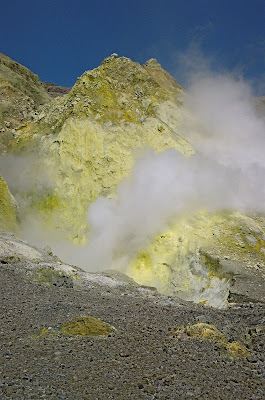
After arriving on the island, we were taken along to see all the sulfur deposits that you see above.
Steam rose from holes in white mounds of minerals. The steam was 100 degrees Celsius and could regularly go up to 300 degrees. They were also able to record temperatures of up to 800 degrees! We had to wear hard hats in case of unexpected eruptions or rock slides and gas masks in case the gas emitted was too strong to breath in.
It was really cool!
These are called sulfur flowers. With the pressure of the steam, little crystalized flower-like formations would appear at the opening of a vent. This is only about a week old.
Amazing what colors nature can give us. I like to think of it as liquid silver and...a yellow like I've never seen. My words betray me here. It was just incredible to see these kinds of colors in such accidental (or not) ways.
More amazing colors. Coppers and moss greens, corals and metallic reds...
Later we reached a section of the island where there was this gigantic crater called the crater complex. Here I am standing in front of it, below.
But the picture doesn't do it just. It was this milky green lake, wispy clouds of steam rising from in one of the most mystically beautiful experiences of my life. A woman I met at the cottage who agreed to drive me to Whakatane with her husband, described the lake as ethereal and in truth, that's the only way to describe it.
Some people say that it's like stepping onto another planet and yes, I guess it is, in a way, but most importantly, it's like stepping into a land of fantasy, one of those comic books or alternate world movies where things like that only seem like figments of our imagination. Nothing that could actually be real.
But somehow, it is real and you do see it for yourself. So, for a moment there, I was mesmerized into silence at the wonder of what our earth can create.
I wanted you to have an idea of what it was like, so I recorded it. The image is not so good, but I'm hoping that it will make you dream, just a little...

After the crater complex, we started heading back to the shore. On the way, we saw plenty of other beautiful things.
Including, real boiling mud pits...
As we neared the shore, we came upon what used to be a sulfur factory. People used to live on this island and mine sulfur. They would have to brush their teeth three times a day to keep them from going black. The best article of clothing to wear was wool because it was the only thing that lasted longer than one month. Everything else wore away because of the minerals and salt from the sea. But wool was a terrible choice because the temperatures could go up into the 30s and it was obviously extremely hot.
Remnants of an old tractor.

What's left of the factory with the yacht in the distance. I love this picture, showing modern man's machines versus the machines of old.

As we headed back to the yacht, there was a very obvious milky quality to the water. That was the current that the sulfur took into the ocean. Apparently, it didn't really affect the sealife there. Many people come here every year to dive in the area. People also come to fish here. They can do that in a very specific area around the island. Things are very reglemented in New Zealand. I think that's the only way they can do that without destroying the things that make New Zealand the pristine country that it is. I'm really impressed with their conservation methods and with how so many people are dedicated in keeping it this way. I have a lot of respect for that.

And because it was such a beautiful day and the waters were calm, we were able to navigate around the island to see what the rest of the island looked like. It wasn't all barren land. On the other side there were traditional New Zealand trees called Pohutukawa. They flower in Christmastime and so are called Christmas trees here. I can't wait for them to bloom.

But a lot of the trees look like this...

They have been chemically burned from the ash falling on them. After the ash falls from an eruption, it rains and the ash turns into a kind of paste which basically burns the trees until they die. No fire or flame is involved, instead it is a slow death.

When it rains on Whakaari and people are visiting it, they get acid rain. They can feel the stinging on their faces. The guide, a woman, cheekily said that it was a free chemical peel. I laughed out loud.

Below a little video of the island to show what the other side looks like. It was a much bigger island than I had expected.